
We will be revising the registration and display system for "Tokyo Stay-in Apartments"
Review evaluation methods and other measures to promote the widespread adoption of more effective stay-at-home evacuation initiatives
Advance preparation is necessary to evacuate to and remain in your familiar apartment building during a disaster. The Tokyo Metropolitan Government operates a system that registers and publicizes apartment buildings where residents can continue living at home even during a disaster as “Tokyo Stay-in-Place Apartments.”
To enhance the effectiveness of mutual aid during disasters, we are revising the registration requirements for disaster prevention activities and introducing a new system that rates efforts to facilitate sheltering in place on a scale of up to five levels. An overview of the revised registration and rating system is provided below.
We encourage you to take this opportunity to utilize these systems to prepare for disasters.
(1) Registration Requirements (Changes indicated by [Note 1])
- 1) Must be earthquake-resistant (buildings confirmed to meet earthquake-resistance standards through compliance with the New Earthquake-Resistance Standards, or through seismic assessment and retrofitting)
- 2) The apartment building must have implemented the following measures:
Software measures (registration is also permitted if an emergency power supply is installed)
Required Information
We have developed a disaster prevention manual
Optional items
Conducting disaster drills at least once a year or establishing a system for confirming
the safety of employees [Note 1]
Website for Business Information

(2) Display of registration stages (Note 2 indicates the changes)
The disaster preparedness level of registered homes is displayed on a 5-point scale [Note 2].
| Stage display | Requirements |
| ☆1 | ・Registration of software countermeasures [Note 2] |
| ☆2 | ・Registration of software countermeasures + registration of one hardware countermeasure [Note 2] |
| ☆3 | ・Registration of software countermeasures + registration of two hardware countermeasures [Note 2] |
| ☆4 [Note 2] | ・Registration of software countermeasures + registration of three hardware countermeasures [Note 2] |
| ☆5 [Note 2] | ・Registration of software countermeasures + registration of 4 hardware countermeasures [Note 2] |
Hardware Solutions
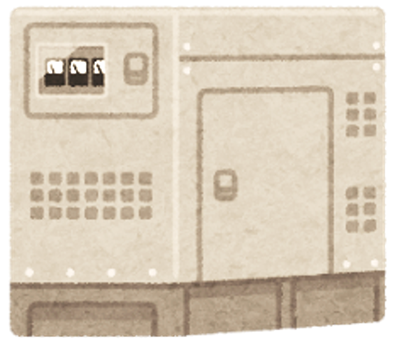
- 1) Installation of an emergency power supply capable of maintaining water supply and operating at least one elevator during a power outage
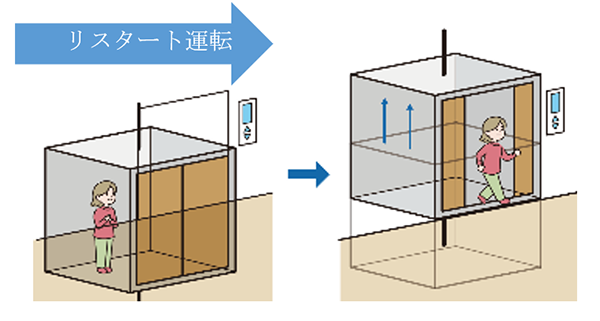
- 2) Installation of measures to prevent elevator entrapment (restart function) [Note 2]
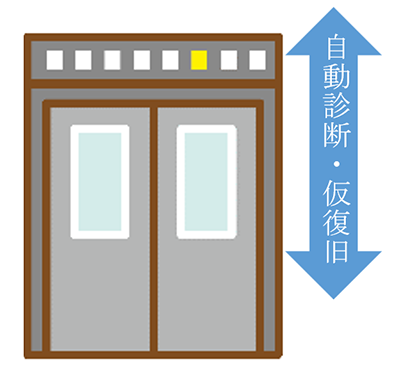
- 3) Implementation of measures for rapid elevator restoration (automatic diagnosis and temporary restoration functions) [Note 2]
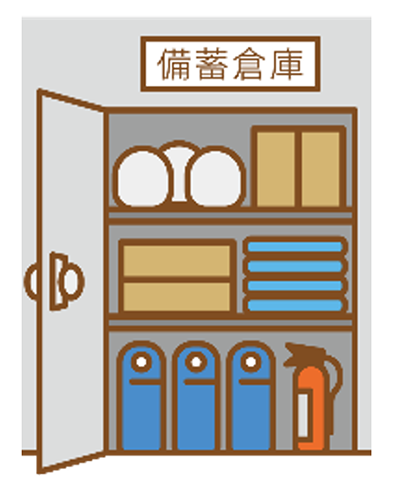
- 4) Securing disaster preparedness supplies and equipment [Note 2]
Conceptual Diagram
(3) Registration Sticker
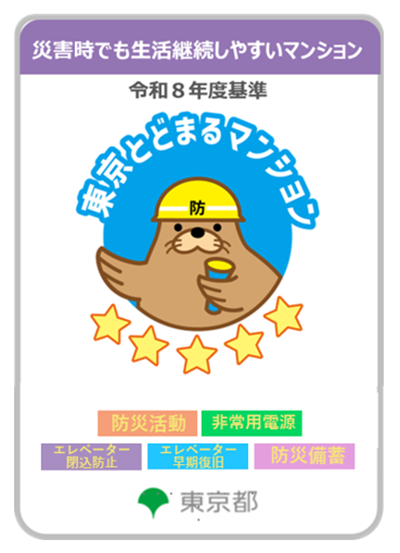
After registration, we will distribute stickers that can be displayed in entrances and other areas. The bottom of the sticker will list the initiatives taken in accordance with the display guidelines.
For details on the key points of the revisions, please refer to Attachment 1 (PDF: 250 KB).
For further information, please visit the program’s website.
This project is an initiative to promote the “Tokyo 2050 Strategy.”
Strategy 22: Disaster Prevention—”Strengthening Community Disaster Resilience”


| Contact: Condominium Section, Private Housing Division, Housing Policy Headquarters Phone: 03-5320-5007 Email: S1090503(at)section.metro.tokyo.jp *The email address has been changed to prevent spam. Please replace (at) with @ when using this email address. |
その他のお知らせ
-
 Earthquake
 -
 Earthquake
 -
 Earthquake
 -
 Earthquake